Ram Bharose Is No Bharosa
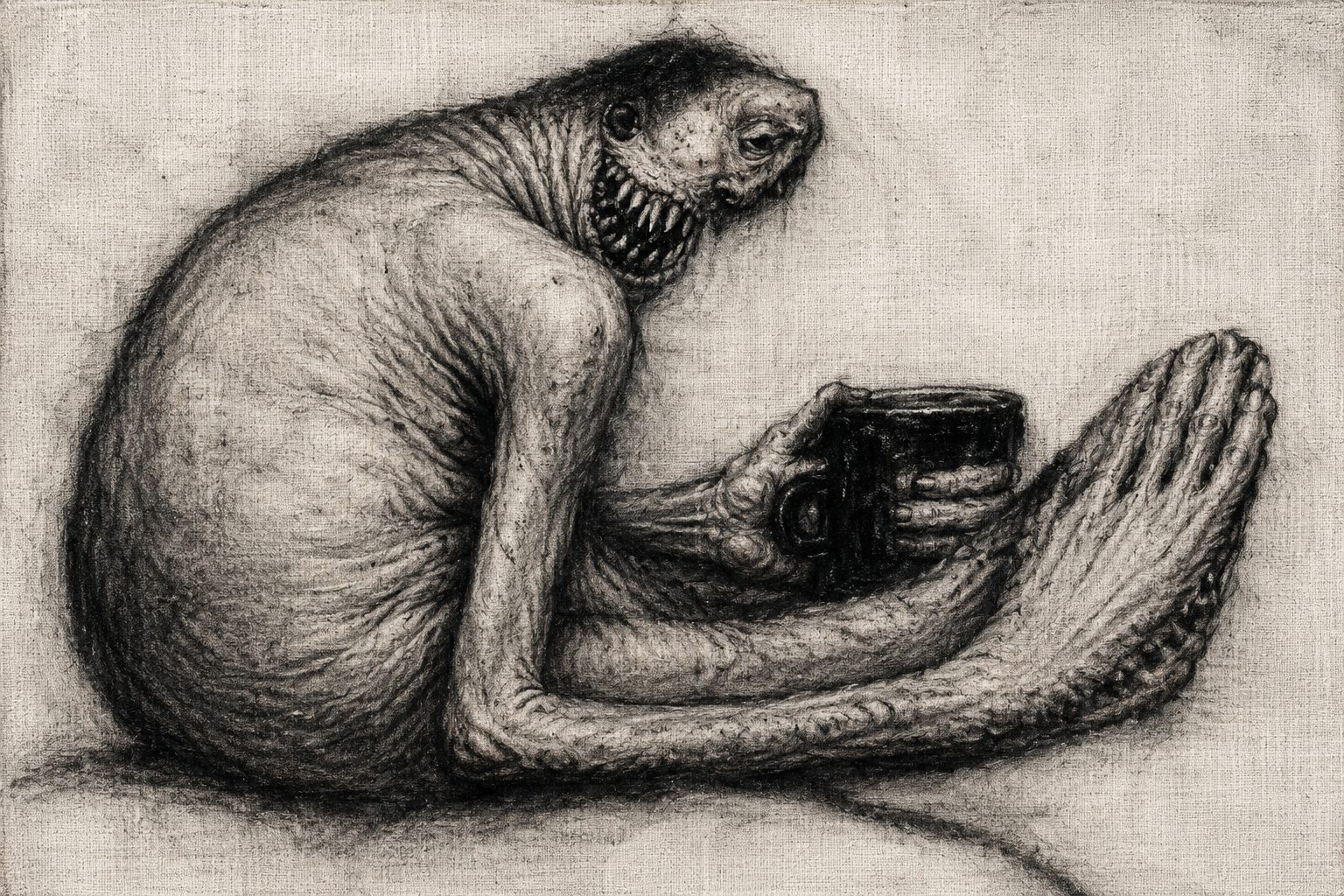
The rice cooker first makes that little wet coughing sound.
Not a whistle. Not a declaration. More like an old government clerk clearing his throat before telling you that your pension file has been misplaced, your application has gone to another department, and the other department may or may not exist depending on whether the fan is working.
I stand in my small room on the South Calcutta fringe and watch the thin starch-fog breathing out of the lid.
Dinner is coming.
Or evidence.
Evidence of what?
Evidence that a man can still operate appliances while his life has already been quietly marked for demolition.
Not heroic demolition. Not cinema demolition, where Amitabh Bachchan walks into the mill compound and the villains suddenly remember morality, trade unionism, and background music. No. This is the Indian kind. Damp plaster behind a cupboard. First there is a bubble. Then a stain. Then black fungus. Then the landlord says, “It was always like this, dada,” and somehow you are paying for the repair.
That is the national technique.
Collapse, but with paperwork missing.
Nobody cares.
This is not complaint. Complaint assumes somebody is listening with a pencil tucked behind the ear. Complaint is still a civilized activity. It imagines a counter, a register, a token number, a glass window, and a human being on the other side who has not yet been replaced by indifference wearing a shirt.
This is closer to diagnosis.
A dull clinical note written in bad handwriting: “Middle-aged male. Educated. Underemployed. Financially fragile. Socially invisible. Politically irrelevant. Still alive, but increasingly theoretical.”
There is a special loneliness in being theoretical while the rice is real.
The rice needs water. The cooker needs electricity. The electricity goes and comes like a politician’s conscience. The body needs food. The landlord needs rent. The phone needs recharge. The job market needs youth, polish, networking, obedience, and a face that says “dynamic” without revealing that the owner of the face knows too much.
A man needs a country.
There lies the joke.
In a civilized country, or at least in a country that has not converted public life into a paan-spit Rorschach test, there would be institutions. Not perfect institutions. I am not some wide-eyed fool who thinks Sweden is full of angels distributing cinnamon buns and justice. But institutions mean that when a man falls, there is at least a railing.
A form.
A number.
A desk.
A second desk.
A bored woman with spectacles who says come Tuesday and actually means Tuesday.
Here, what do we have?
Ram bharose.
And let us not insult Ram by pretending this is faith. Ram bharose is not trust. It is the national shrug wearing a tilak. It means the bridge may stand, the medicine may work, the job may come, the file may move, the court may decide, the doctor may care, the police may answer, the employer may call, the pension may arrive, the hospital oxygen may not run out, the contractor may not steal, the bank may not cheat, and the ceiling fan may not detach during a power-cut afternoon while you are lying in your vest wondering whether your life has become one long unpaid invoice.
Ram bharose is not bharosa.
It is administrative abandonment with devotional background music.
And India, my beloved, infuriating, mother-tongued, dust-choked, sweet-shop-smelling, genius-producing, cruelty-normalizing India, has perfected a beautiful seasonal crop called public benevolence. It appears before elections, like hilsa in the market, except hilsa at least has the decency to be honestly oily.
Suddenly roads are patched. Ration cards are remembered. Gas cylinders acquire moral significance. The poor are photographed. The old are garlanded. The unemployed are promised. The youth are patted like goats before Eid. Every party, every side, every ideological vendor opens the same tin trunk of cheap compassion and says, “See? We care.”
After elections, compassion is folded back, sprinkled with naphthalene, and stored for the next campaign.
Unless, of course, you are connected to the people on the chair.
Then benevolence is not seasonal. It is irrigation.
Your little field is watered constantly. Tender, contract, permission, police protection, hospital bed, school admission, municipal mercy, bank tolerance, court delay, tax forgiveness: the republic bends down like a trained elephant and lets you climb on its neck.
For the rest of us: stand in line, die quietly, don’t block traffic.
I am an educated man without employment, which sounds strange only to people who still believe education and employment are connected by some moral railway line. They are not. In India, they are two stations built by different contractors in different districts, and the connecting bridge has been inaugurated six times but never completed.
A degree may get you respect from dead relatives.
It will not necessarily get you work after fifty.
Not if you do not belong to a lobby, a family machine, a caste-network of opportunity, a corporate ladder already entered at twenty-five, or that oily fraternity of smiling liars who can say “Absolutely, sir” while their spine slides down their trouser leg like cooked okra.
There is ageism here.
Not the polite Western kind where a company sends you an email about “moving forward with other candidates.” That is at least cruelty with stationery. Here the hatred has body odour. It looks at your age and sees expiry. It looks at your honesty and sees inconvenience. It looks at your refusal to flatter stupidity and sees danger.
A man who says the system is broken is treated as more broken than the system.
Because the system has many fathers.
Truth has none.
In India, if your spine has not been softened by fear, compromise, office politics, family pressure, marriage-market arithmetic, spiritual blackmail, or the national pastime of bending before the powerful and barking at the weak, then you become a problem. Not a grand revolutionary problem. Don’t flatter yourself. You become an awkward chair in a small room. People move around you. They don’t invite you. They say you are “difficult,” which is the polite Bengali way of saying, “This fellow does not lick boot properly.”
And then comes AI, the shiny new god with data-center lungs and venture-capital teeth, and everyone starts shouting as if unemployment was invented last Thursday by a chatbot in California.
My dear chuckle-headed prophets, India had unemployment before AI the way Bengal had humidity before air-conditioning.
AI is not the tiger entering the village.
The tiger has been living in the village for decades, drinking tea at the club, giving speeches, and hiring nephews.
AI may sharpen the blade, yes. It may automate contempt. It may allow twenty-five-year-old managers with motivational LinkedIn faces to reject fifty-year-old workers faster, with better grammar. It may polish the old cruelty until it shines like a new pressure cooker in Gariahat.
But the contempt was already here.
The old are not wanted.
The honest are not wanted.
The complicated are not wanted.
The sick are tolerated only if they are rich enough to make illness look dignified.
The poor sick must become either religious testimony, political statistic, or family burden.
Preferably out of sight.
There is a biology to all this, and it is not poetic. The body does not collapse like a government press conference, suddenly and with microphones. It economizes. First appetite becomes negotiation. Then protein becomes luxury. Then fruit becomes memory. Then teeth go. Then hair goes. Then the muscles begin to look like a committee that has lost quorum.
The brain, that expensive electricity-guzzling bastard, starts dimming lights in unused rooms.
Ambition takes voluntary retirement.
Pride develops acidity.
Libido sits in the corner like a retired Durga Puja drummer who still remembers rhythm but no longer gets called.
Slow starvation is not dramatic.
It is spreadsheet death.
Calories in, calories out. Rupees in, rupees out. Hope in, shame out. One column bleeding into another until arithmetic itself begins to smell faintly of old socks, boiled rice, and unpaid rent.
People imagine hunger as ribs, large eyes, and documentary music. But hunger in a lower-middle-class educated man can look almost respectable for a long time.
He still has books.
He still knows the difference between correlation and causation.
He can still explain why a bad system fails.
He can still make tea.
He can still type complete sentences.
He may even make jokes.
That is the cruel part.
Decay does not immediately remove vocabulary.
You can be dissolving and still use semicolons correctly.
As a child I was apparently a bright boy. This is one of those phrases relatives preserve like old wedding utensils. “Bright boy.” It has a nice brass sound. Teachers liked me. I read books. I thought intelligence was a passport. Later I learned it was more like a railway ticket to a station where the platform had been sold to a mall developer.
A bright boy becomes a man.
The man studies.
The man works.
The man returns.
The man tries.
The man refuses to lie fluently enough.
The man gets older.
The man watches doors close with the soft efficiency of automatic elevators.
The man writes posts because writing is cheaper than therapy and more available than justice.
Writing, at my level of income, is not literature. Please do not garland the wound. This is not art in the drawing-room sense, with wine, panel discussion, and a young moderator saying “trauma” as if it were a scented candle.
This is a man bailing dirty water from a sinking boat with a cracked plastic mug.
Sometimes the water is funny.
Sometimes a dead cockroach floats by and looks more employable than him.
A kakistocracy is not merely rule by the worst. That sounds too clean, too dictionary-polished, like something a professor says while adjusting his shawl. A kakistocracy is what happens when incompetence becomes culture, cruelty becomes process, flattery becomes currency, and every institution is hollowed out until only the signboard remains.
Hospital.
School.
Court.
Parliament.
Police.
University.
Bank.
All signboards. Many lights. Much ribbon. Regular inauguration. Very little soul.
And we, the unconnected, the ageing, the inconvenient, the not-photogenic poor, move among these signboards like ghosts who have forgotten the address of their own haunting.
Sometimes I think my end will not be dramatic at all. No thunder. No final speech. No one saying, “He had potential.” Potential is a word people use when they don’t want to pay you in the present. It is a promissory note issued by the past and dishonoured by the future.
Maybe the end will be smaller.
A skipped meal becoming a habit.
A toothache becoming an infection.
A fever postponed because the doctor costs money.
A medicine strip cut carefully with scissors.
Rice stretched.
Tea thinned.
Body reduced.
Mind still muttering.
The final great Indian trick is to make a man participate in his own disappearance by calling it adjustment.
Adjust, dada.
Manage, dada.
Be practical, dada.
Don’t be negative, dada.
Think positive, dada.
Network, dada.
Upskill, dada.
Do meditation, dada.
Believe, dada.
The whole country stands over the fallen man like an uncle at a wedding giving advice while not paying for the ambulance.
I know life is not fair. Only children and motivational speakers expect fairness. But unfairness has degrees. There is the unfairness of rain on picnic day, and then there is the unfairness of being born into a society where the public floor is deliberately greased and the fallen are lectured on balance.
I am not asking for pity.
Pity is thin soup, usually oversalted.
I am saying this plainly because plainness is the last small property I own.
Nobody cares.
Not in the cosmic sense, which is fine. The universe is under no obligation to notice a Bengali man in a rented room making rice in an electric cooker. Stars explode. Galaxies collide. Neutrinos pass through my sad body by the trillion, politely ignoring my financial condition.
But a republic is supposed to care a little.
That was the deal, no?
We gave up kingdoms, at least on paper. We wrote laws. We made institutions. We printed constitutions. We taught schoolchildren that citizens matter. Then slowly, like termites with national flags, the powerful ate the beams and left us standing under the paint.
So now I sit with my rice, my tea, my aging face, my unemployed education, my unmarketable honesty, my broken pride, my ridiculous still-functioning brain, and I watch myself turn from person into residue.
Not ash.
Not yet.
More like the sticky starch at the bottom of the cooker when the water is wrong and the heat has been too much, and you scrape it with a spoon because wasting food is sin, comedy, economics, and autobiography all at once.
Outside, someone is shouting into a phone. Somewhere a politician is promising dignity. Somewhere a young man with good teeth is recording a video about opportunity. Somewhere a godman is monetizing peace. Somewhere a recruiter is looking for “young dynamic talent.” Somewhere a bright boy is being praised by a teacher and has not yet learned that brightness does not stop mould.
I eat the rice before it hardens.
Even despair tastes worse cold.